
记录一下最近这学期学习的sylar服务器框架项目,输出整理一下项目的结构,用到的知识和自己的体会
项目仓库地址
https://github.com/sylar-yin/sylar/
整理博客过程中参考的大佬资料链接:
============================================
基础介绍
HttpConnection模块能让服务器像客户端一样发送http请求报文的能力
该模块主要由URI模块,继承自SocketStream的HttpConnection类,HttpResult类以及HttpConnectionPool类组成
URI模块
定义了一个URI类,可以完成URI的解析,基于有限状态机ragel进行解析
/*
     foo://user@sylar.com:8042/over/there?name=ferret#nose
       \_/   \______________/\_________/ \_________/ \__/
        |           |            |            |        |
     scheme     authority       path        query   fragment
*/

// URI类
class Uri {
public:
    typedef std::shared_ptr
<Uri> ptr;

    static Uri::ptr Create(const std::string& uri);     // 创建URI
    Uri();

    const std::string& getScheme() const { return m_scheme; }
    const std::string& getUserinfo() const { return m_userinfo; }
    const std::string& getHost() const { return m_host; }
    const std::string& getPath() const;
    const std::string& getQuery() const { return m_query; }
    const std::string& getFragment() const { return m_fragment; }
    int32_t getPort() const;

    void setScheme(const std::string& v) { m_scheme = v; }
    void setUserinfo(const std::string& v) { m_userinfo = v; }
    void setHost(const std::string& v) { m_host = v; }
    void setPath(const std::string& v) { m_path = v; }
    void setQuery(const std::string& v) { m_query = v; }
    void setFragment(const std::string& v) { m_fragment = v; }
    void setPort(int32_t v) { m_port = v;}

    std::ostream& dump(std::ostream& os) const;     // 转字符串并插到流
    std::string toString() const;                   // 转成字符串
    Address::ptr createAddress() const;             // 使用URI的host字段创建地址
private:
    bool isDefaultPort() const;         // 是否为默认端口(80 443)
private:
    std::string m_scheme;       // scheme
    std::string m_userinfo;     // 用户信息
    std::string m_host;         // 主机
    std::string m_path;         // 路径
    std::string m_query;        // 查询参数(?)
    std::string m_fragment;     // fragment(#)
    int32_t     m_port;         // 端口
};
有限状态机源代码uri.rl如下
#include "uri.h"
#include
<sstream>

namespace sylar {
%%{
    # See RFC 3986: http://www.ietf.org/rfc/rfc3986.txt

    machine uri_parser;

    gen_delims = ":" | "/" | "?" | "#" | "[" | "]" | "@";
    sub_delims = "!" | "$" | "&" | "'" | "(" | ")" | "*" | "+" | "," | ";" | "=";
    reserved = gen_delims | sub_delims;
    unreserved = alpha | digit | "-" | "." | "_" | "~";
    pct_encoded = "%" xdigit xdigit;

    action marku { mark = fpc; }
    action markh { mark = fpc; }

    action save_scheme
    {
        uri->setScheme(std::string(mark, fpc - mark));
        mark = NULL;
    }

    scheme = (alpha (alpha | digit | "+" | "-" | ".")*) >marku %save_scheme;

    action save_port
    {
        if (fpc != mark) {
            uri->setPort(atoi(mark));
        }
        mark = NULL;
    }
    action save_userinfo
    {
        if(mark) {
            //std::cout << std::string(mark, fpc - mark) << std::endl;
            uri->setUserinfo(std::string(mark, fpc - mark));
        }
        mark = NULL;
    }
    action save_host
    {
        if (mark != NULL) {
            //std::cout << std::string(mark, fpc - mark) << std::endl;
            uri->setHost(std::string(mark, fpc - mark));
        }
    }

    userinfo = (unreserved | pct_encoded | sub_delims | ":")*;
    dec_octet = digit | [1-9] digit | "1" digit{2} | 2 [0-4] digit | "25" [0-5];
    IPv4address = dec_octet "." dec_octet "." dec_octet "." dec_octet;
    h16 = xdigit{1,4};
    ls32 = (h16 ":" h16) | IPv4address;
    IPv6address = (                         (h16 ":"){6} ls32) |
                  (                    "::" (h16 ":"){5} ls32) |
                  ((             h16)? "::" (h16 ":"){4} ls32) |
                  (((h16 ":"){1} h16)? "::" (h16 ":"){3} ls32) |
                  (((h16 ":"){2} h16)? "::" (h16 ":"){2} ls32) |
                  (((h16 ":"){3} h16)? "::" (h16 ":"){1} ls32) |
                  (((h16 ":"){4} h16)? "::"              ls32) |
                  (((h16 ":"){5} h16)? "::"              h16 ) |
                  (((h16 ":"){6} h16)? "::"                  );
    IPvFuture = "v" xdigit+ "." (unreserved | sub_delims | ":")+;
    IP_literal = "[" (IPv6address | IPvFuture) "]";
    reg_name = (unreserved | pct_encoded | sub_delims)*;
    host = IP_literal | IPv4address | reg_name;
    port = digit*;

    authority = ( (userinfo %save_userinfo "@")? host >markh %save_host (":" port >markh %save_port)? ) >markh;

    action save_segment
    {
        mark = NULL;
    }

    action save_path
    {
            //std::cout << std::string(mark, fpc - mark) << std::endl;
        uri->setPath(std::string(mark, fpc - mark));
        mark = NULL;
    }

#    pchar = unreserved | pct_encoded | sub_delims | ":" | "@";
# add (any -- ascii) support chinese
    pchar         = ( (any -- ascii ) | unreserved | pct_encoded | sub_delims | ":" | "@" ) ;
    segment = pchar*;
    segment_nz = pchar+;
    segment_nz_nc = (pchar - ":")+;

    action clear_segments
    {
    }

    path_abempty = (("/" segment))? ("/" segment)*;
    path_absolute = ("/" (segment_nz ("/" segment)*)?);
    path_noscheme = segment_nz_nc ("/" segment)*;
    path_rootless = segment_nz ("/" segment)*;
    path_empty = "";
    path = (path_abempty | path_absolute | path_noscheme | path_rootless | path_empty);

    action save_query
    {
        //std::cout << std::string(mark, fpc - mark) << std::endl;
        uri->setQuery(std::string(mark, fpc - mark));
        mark = NULL;
    }
    action save_fragment
    {
        //std::cout << std::string(mark, fpc - mark) << std::endl;
        uri->setFragment(std::string(mark, fpc - mark));
        mark = NULL;
    }

    query = (pchar | "/" | "?")* >marku %save_query;
    fragment = (pchar | "/" | "?")* >marku %save_fragment;

    hier_part = ("//" authority path_abempty > markh %save_path) | path_absolute | path_rootless | path_empty;

    relative_part = ("//" authority path_abempty) | path_absolute | path_noscheme | path_empty;
    relative_ref = relative_part ( "?" query )? ( "#" fragment )?;

    absolute_URI = scheme ":" hier_part ( "?" query )? ;
    # Obsolete, but referenced from HTTP, so we translate
    relative_URI = relative_part ( "?" query )?;

    URI = scheme ":" hier_part ( "?" query )? ( "#" fragment )?;
    URI_reference = URI | relative_ref;
    main := URI_reference;
    write data;
}%%

Uri::ptr Uri::Create(const std::string& uristr) {
    Uri::ptr uri(new Uri);
    int cs = 0;
    const char* mark = 0;
    %% write init;
    const char *p = uristr.c_str();
    const char *pe = p + uristr.size();
    const char* eof = pe;
    %% write exec;
    if(cs == uri_parser_error) {
        return nullptr;
    } else if(cs >= uri_parser_first_final) {
        return uri;
    }
    return nullptr;
}

Uri::Uri()
    :m_port(0) {
}

bool Uri::isDefaultPort() const {
    if(m_port == 0) {
        return true;
    }
    if(m_scheme == "http"
            || m_scheme == "ws") {
        return m_port == 80;
    } else if(m_scheme == "https"
            || m_scheme == "wss") {
        return m_port == 443;
    }
    return false;
}

const std::string& Uri::getPath() const {
    static std::string s_default_path = "/";
    return m_path.empty() ? s_default_path : m_path;
}

int32_t Uri::getPort() const {
    if(m_port) {
        return m_port;
    }
    if(m_scheme == "http"
        || m_scheme == "ws") {
        return 80;
    } else if(m_scheme == "https"
            || m_scheme == "wss") {
        return 443;
    }
    return m_port;
}

std::ostream& Uri::dump(std::ostream& os) const {
    os << m_scheme << "://"
       << m_userinfo
       << (m_userinfo.empty() ? "" : "@")
       << m_host
       << (isDefaultPort() ? "" : ":" + std::to_string(m_port))
       << getPath()
       << (m_query.empty() ? "" : "?")
       << m_query
       << (m_fragment.empty() ? "" : "#")
       << m_fragment;
    return os;
}

std::string Uri::toString() const {
    std::stringstream ss;
    dump(ss);
    return ss.str();
}

Address::ptr Uri::createAddress() const {
    auto addr = Address::LookupAnyIPAddress(m_host);
    if(addr) {
        addr->setPort(getPort());
    }
    return addr;
}

}
HttpResult
该结构体用于存储HTTP响应结果
// HTTP响应结果类
struct HttpResult {
    typedef std::shared_ptr
<HttpResult> ptr;
    // 错误枚举
    enum class Error {
        OK = 0,                         // 正常
        INVALID_URL = 1,                // 非法URL
        INVALID_HOST = 2,               // 无法解析host
        CONNECT_FAIL = 3,               // 连接失败
        SEND_CLOSE_BY_PEER = 4,         // 连接被对端关闭
        SEND_SOCKET_ERROR = 5,          // 发送请求产生socket错误
        TIMEOUT = 6,                    // 超时
        CREATE_SOCK_ERROR = 7,          // 创建socket失败
        POOL_GET_CONNECTION = 8,        // 从连接池中获取连接失败
        POOL_INVALID_CONNECTION = 9     // 连接池无效的连接
    };
    HttpResult(int _result, HttpResponse::ptr _response, const std::string& _error)
        :result(_result)
        ,response(_response)
        ,error(_error) {}

    int result;                     // 错误码
    HttpResponse::ptr response;     // HTTP响应类
    std::string error;              // 错误描述

    std::string toString() const;   // 字符串方法
};

std::string HttpResult::toString() const {
    std::stringstream ss;
    ss << "[HttpResult result=" << result
       << " error=" << error
       << " response=" << (response ? response->toString() : "nullptr")
       << "]";
    return ss.str();
}
HttpConnection
SocketStream的子类,提供了发送各种方法请求的接口
// HTTP连接类(继承自SocketStream)
class HttpConnection : public SocketStream {
friend class HttpConnectionPool;
public:
    typedef std::shared_ptr
<HttpConnection> ptr;

    // 发送GET请求(url字符串)
    static HttpResult::ptr DoGet(const std::string& url
                                , uint64_t timeout_ms
                                , const std::map<std::string, std::string>& headers = {}
                                , const std::string& body = "");

    // 发送GET请求(Uri指针)
    static HttpResult::ptr DoGet(Uri::ptr uri
                                , uint64_t timeout_ms
                                , const std::map<std::string, std::string>& headers = {}
                                , const std::string& body = "");

    // 发送POST请求(URL字符串)
    static HttpResult::ptr DoPost(const std::string& url
                                , uint64_t timeout_ms
                                , const std::map<std::string, std::string>& headers = {}
                                , const std::string& body = "");

    // 发送POST请求(Uri指针)
    static HttpResult::ptr DoPost(Uri::ptr uri
                                , uint64_t timeout_ms
                                , const std::map<std::string, std::string>& headers = {}
                                , const std::string& body = "");

    // 发送请求(URL字符串)
    static HttpResult::ptr DoRequest(HttpMethod method
                                , const std::string& url
                                , uint64_t timeout_ms
                                , const std::map<std::string, std::string>& headers = {}
                                , const std::string& body = "");

    // 发送请求(Uri指针)
    static HttpResult::ptr DoRequest(HttpMethod method
                                , Uri::ptr uri
                                , uint64_t timeout_ms
                                , const std::map<std::string, std::string>& headers = {}
                                , const std::string& body = "");

    // 发送请求(HttpRequest指针)
    static HttpResult::ptr DoRequest(HttpRequest::ptr req
                                , Uri::ptr uri
                                , uint64_t timeout_ms);

    HttpConnection(Socket::ptr sock, bool owner = true);
    ~HttpConnection();
    HttpResponse::ptr recvResponse();           // 接收响应报文
    int sendRequest(HttpRequest::ptr req);      // 发送请求报文
private:
    uint64_t m_createTime = 0;      // 创建时间
    uint64_t m_request = 0;         // 请求超时时间
};

HttpConnection::HttpConnection(Socket::ptr sock, bool owner)
    :SocketStream(sock, owner) {
}

HttpConnection::~HttpConnection() {
    SYLAR_LOG_DEBUG(g_logger) << "HttpConnection::~HttpConnection";
}

HttpResponse::ptr HttpConnection::recvResponse() {
    // 创建解析器
    HttpResponseParser::ptr parser(new HttpResponseParser);
    uint64_t buff_size = HttpRequestParser::GetHttpRequestBufferSize();
    // 智能指针接管
    std::shared_ptr
<char> buffer(
        new char[buff_size + 1], [](char* ptr){
            delete[] ptr;
        });
    char* data = buffer.get();
    int offset = 0;
    // 解析工作循环
    do {
        int len = read(data + offset, buff_size - offset);
        if(len <= 0) {
            close();
            return nullptr;
        }
        len += offset;
        data[len] = '\0';
        size_t nparse = parser->execute(data, len, false);
        if(parser->hasError()) {
            close();
            return nullptr;
        }
        offset = len - nparse;
        if(offset == (int)buff_size) {
            close();
            return nullptr;
        }
        if(parser->isFinished()) {
            break;
        }
    } while(true);
    auto client_parser = parser->getParser();
    // 如果chunk
    if(client_parser.chunked) {
        std::string body;
        int len = offset;
        do {
            do {
                int rt = read(data + len, buff_size - len);
                if(rt <= 0) {
                    close();
                    return nullptr;
                }
                len += rt;
                data[len] = '\0';
                size_t nparse = parser->execute(data, len, true);
                if(parser->hasError()) {
                    close();
                    return nullptr;
                }
                len -= nparse;
                if(len == (int)buff_size) {
                    close();
                    return nullptr;
                }
            } while(!parser->isFinished());
            len -= 2;

            SYLAR_LOG_INFO(g_logger) << "content_len=" << client_parser.content_len;
            if(client_parser.content_len <= len) {
                body.append(data, client_parser.content_len);
                memmove(data, data + client_parser.content_len
                        , len - client_parser.content_len);
                len -= client_parser.content_len;
            } else {
                body.append(data, len);
                int left = client_parser.content_len - len;
                while(left > 0) {
                    int rt = read(data, left > (int)buff_size ? (int)buff_size : left);
                    if(rt <= 0) {
                        close();
                        return nullptr;
                    }
                    body.append(data, rt);
                    left -= rt;
                }
                len = 0;
            }
        } while(client_parser.chunks_done);
        parser->getData()->setBody(body);
    } else {    // 非chunk
        int64_t length = parser->getContentLength();
        if(length > 0) {
            std::string body;
            body.resize(length);

            int len = 0;
            if(length >= offset) {
                memcpy(&body[0], data, length);
                len = offset;
            } else {
                memcpy(&body[0], data, length);
                len = length;
            }
            length -= offset;
            if(length > 0) {
                if(readFixSize(&body[len], length) <= 0) {
                    close();
                    return nullptr;
                }
            }
            parser->getData()->setBody(body);
        }
    }
    // 返回解析完毕数据
    return parser->getData();
}

int HttpConnection::sendRequest(HttpRequest::ptr req) {
    std::stringstream ss;
    ss << *req;
    std::string data = ss.str();
    return writeFixSize(data.c_str(), data.size());
}

HttpResult::ptr HttpConnection::DoGet(const std::string& url
                                , uint64_t timeout_ms
                                , const std::map<std::string, std::string>& headers
                                , const std::string& body) {
    Uri::ptr uri = Uri::Create(url);
    if(!uri) {
        return std::make_shared
<HttpResult>((int)HttpResult::Error::INVALID_URL
                    , nullptr, "invalid url: " + url);
    }
    return DoGet(uri, timeout_ms, headers, body);
}

// ...
HttpConnectionPool
仅在长连接时有效,预备一池子的HttpConnection指针,复用http连接
// HTTP连接池(仅在Connection: keep-alive时有效)
class HttpConnectionPool {
public:
    typedef std::shared_ptr
<HttpConnectionPool> ptr;
    typedef Mutex MutexType;

    HttpConnectionPool(const std::string& host
                    , const std::string& vhost
                    , uint32_t port
                    , uint32_t max_size
                    , uint32_t max_alive_time
                    , uint32_t max_request);

    HttpConnection::ptr getConnection();        // 获得连接

    HttpResult::ptr doGet(const std::string& url
                          , uint64_t timeout_ms
                          , const std::map<std::string, std::string>& headers = {}
                          , const std::string& body = "");
    HttpResult::ptr doGet(Uri::ptr uri
                           , uint64_t timeout_ms
                           , const std::map<std::string, std::string>& headers = {}
                           , const std::string& body = "");
    HttpResult::ptr doPost(const std::string& url
                           , uint64_t timeout_ms
                           , const std::map<std::string, std::string>& headers = {}
                           , const std::string& body = "");
    HttpResult::ptr doPost(Uri::ptr uri
                           , uint64_t timeout_ms
                           , const std::map<std::string, std::string>& headers = {}
                           , const std::string& body = "");
    HttpResult::ptr doRequest(HttpMethod method
                            , const std::string& url
                            , uint64_t timeout_ms
                            , const std::map<std::string, std::string>& headers = {}
                            , const std::string& body = "");
    HttpResult::ptr doRequest(HttpMethod method
                            , Uri::ptr uri
                            , uint64_t timeout_ms
                            , const std::map<std::string, std::string>& headers = {}
                            , const std::string& body = "");
    HttpResult::ptr doRequest(HttpRequest::ptr req
                            , uint64_t timeout_ms);
private:
    static void ReleasePtr(HttpConnection* ptr, HttpConnectionPool* pool);      // 释放连接
private:
    std::string m_host;                     // 主机
    std::string m_vhost;
    uint32_t m_port;                        // 端口
    uint32_t m_maxSize;                     // 连接最大数
    uint32_t m_maxAliveTime;                // 连接时长
    uint32_t m_maxRequest;                  // 请求时长

    MutexType m_mutex;                      // 互斥锁
    std::list<HttpConnection*> m_conns;     // HttpConnection指针链表
    std::atomic
<int32_t> m_total = {0};     // 连接的数量
};

HttpConnectionPool::HttpConnectionPool(const std::string& host
                    , const std::string& vhost
                    , uint32_t port
                    , uint32_t max_size
                    , uint32_t max_alive_time
                    , uint32_t max_request)
    :m_host(host)
    ,m_vhost(vhost)
    ,m_port(port)
    ,m_maxSize(max_size)
    ,m_maxAliveTime(max_alive_time)
    ,m_maxRequest(max_request) {
}

HttpConnection::ptr HttpConnectionPool::getConnection() {
    uint64_t now_ms = sylar::GetCurrentMs();
    std::vector<HttpConnection*> invalid_conns;
    HttpConnection* ptr = nullptr;
    Mutex::Lock lock(m_mutex);
    // 若连接池不为空,取出一个connection
    while(!m_conns.empty()) {
        auto conn = *m_conns.begin();
        m_conns.pop_front();
        if(!conn->isConnected()) {
            invalid_conns.push_back(conn);
            continue;
        }
        if((conn->m_createTime + m_maxAliveTime) > now_ms) {
            invalid_conns.push_back(conn);
            continue;
        }
        ptr = conn;
        break;
    }
    lock.unlock();

    // 删除非法连接
    for(auto i : invalid_conns) {
        delete i;
    }
    m_total -= invalid_conns.size();

    // 若没有连接
    if(!ptr) {
        // 创建地址
        IPAddress::ptr addr = Address::LookupAnyIPAddress(m_host);
        if(!addr) {
            SYLAR_LOG_ERROR(g_logger) << "get addr fail: " << *addr;
            return nullptr;
        }
        // 设置端口
        addr->setPort(m_port);
        Socket::ptr sock = Socket::CreateTCP(addr);
        if(!sock) {
            SYLAR_LOG_ERROR(g_logger) << "create sock fail: " << *addr;
            return nullptr;
        }
        // 连接
        if(!sock->connect(addr)) {
            SYLAR_LOG_ERROR(g_logger) << "sock connect fail: " << *addr;
            return nullptr;
        }

        ptr = new HttpConnection(sock);
        m_total++;
    }
    return HttpConnection::ptr(ptr, std::bind(&HttpConnectionPool::ReleasePtr
                                , std::placeholders::_1, this));
}

void HttpConnectionPool::ReleasePtr(HttpConnection* ptr, HttpConnectionPool* pool) {
    ptr->m_request++;
    if(!ptr->isConnected()
            || ((ptr->m_createTime + pool->m_maxAliveTime) >= sylar::GetCurrentMs())
            || (ptr->m_request >= pool->m_maxRequest)) {
        delete ptr;
        pool->m_total--;
        return;
    }
    MutexType::Lock lock(pool->m_mutex);
    // 重新加入连接池
    pool->m_conns.push_back(ptr);
}

HttpResult::ptr HttpConnectionPool::doGet(const std::string& url
                                        , uint64_t timeout_ms
                                        , const std::map<std::string, std::string>& headers
                                        , const std::string& body) {
    return doRequest(HttpMethod::GET, url, timeout_ms, headers, body);
}

HttpResult::ptr HttpConnectionPool::doGet(Uri::ptr uri
                           , uint64_t timeout_ms
                           , const std::map<std::string, std::string>& headers
                           , const std::string& body) {
    std::stringstream ss;
    ss << uri->getPath()
        << (uri->getQuery().empty() ? "" : "?")
        << uri->getQuery()
        << (uri->getFragment().empty() ? "" : "#")
        << uri->getFragment();
    return doGet(ss.str(), timeout_ms, headers, body);
}

HttpResult::ptr HttpConnectionPool::doPost(const std::string& url
                                        , uint64_t timeout_ms
                                        , const std::map<std::string, std::string>& headers
                                        , const std::string& body) {
    return doRequest(HttpMethod::POST, url, timeout_ms, headers, body);
}

// ...

HttpResult::ptr HttpConnectionPool::doRequest(HttpMethod method
                                            , const std::string& url
                                            , uint64_t timeout_ms
                                            , const std::map<std::string, std::string>& headers
                                            , const std::string& body) {
    HttpRequest::ptr req = std::make_shared
<HttpRequest>();
    req->setPath(url);
    req->setMethod(method);
    req->setClose(false);
    bool has_host = false;
    for(auto& i : headers) {
        if(strcasecmp(i.first.c_str(), "connection") == 0) {
            if(strcasecmp(i.second.c_str(), "keep-alive") == 0) {
                req->setClose(false);
            }
            continue;
        }

        if(!has_host && strcasecmp(i.first.c_str(), "host") == 0) {
            has_host = !i.second.empty();
        }

        req->setHeader(i.first, i.second);
    }
    if(!has_host) {
        if(m_vhost.empty()) {
            req->setHeader("Host", m_host);
        } else {
            req->setHeader("Host", m_vhost);
        }
    }
    req->setBody(body);
    return doRequest(req, timeout_ms);
}

HttpResult::ptr HttpConnectionPool::doRequest(HttpMethod method
                                            , Uri::ptr uri
                                            , uint64_t timeout_ms
                                            , const std::map<std::string, std::string>& headers
                                            , const std::string& body) {
    std::stringstream ss;
    ss << uri->getPath()
        << (uri->getQuery().empty() ? "" : "?")
        << uri->getQuery()
        << (uri->getFragment().empty() ? "" : "#")
        << uri->getFragment();
    return doRequest(method, ss.str(), timeout_ms, headers, body);
}

HttpResult::ptr HttpConnectionPool::doRequest(HttpRequest::ptr req
                                            , uint64_t timeout_ms) {
    auto conn = getConnection();
    if(!conn) {
        return std::make_shared
<HttpResult>((int)HttpResult::Error::POOL_GET_CONNECTION
                , nullptr, "pool host:" + m_host + " port:" + std::to_string(m_port));
    }
    auto sock = conn->getSocket();
    if(!sock) {
        return std::make_shared
<HttpResult>((int)HttpResult::Error::POOL_INVALID_CONNECTION
                , nullptr, "pool host:" + m_host + " port:" + std::to_string(m_port));
    }
    sock->setRecvTimeout(timeout_ms);
    int rt = conn->sendRequest(req);
    if(rt == 0) {
        return std::make_shared
<HttpResult>((int)HttpResult::Error::SEND_CLOSE_BY_PEER
                , nullptr, "send request closed by peer: " + sock->getRemoteAddress()->toString());
    }
    if(rt < 0) {
        return std::make_shared
<HttpResult>((int)HttpResult::Error::SEND_SOCKET_ERROR
                    , nullptr, "send request socket error errno=" + std::to_string(errno)
                    + " errstr=" + std::string(strerror(errno)));
    }
    auto rsp = conn->recvResponse();
    if(!rsp) {
        return std::make_shared
<HttpResult>((int)HttpResult::Error::TIMEOUT
                    , nullptr, "recv response timeout: " + sock->getRemoteAddress()->toString()
                    + " timeout_ms:" + std::to_string(timeout_ms));
    }
    return std::make_shared
<HttpResult>((int)HttpResult::Error::OK, rsp, "ok");
}
测试
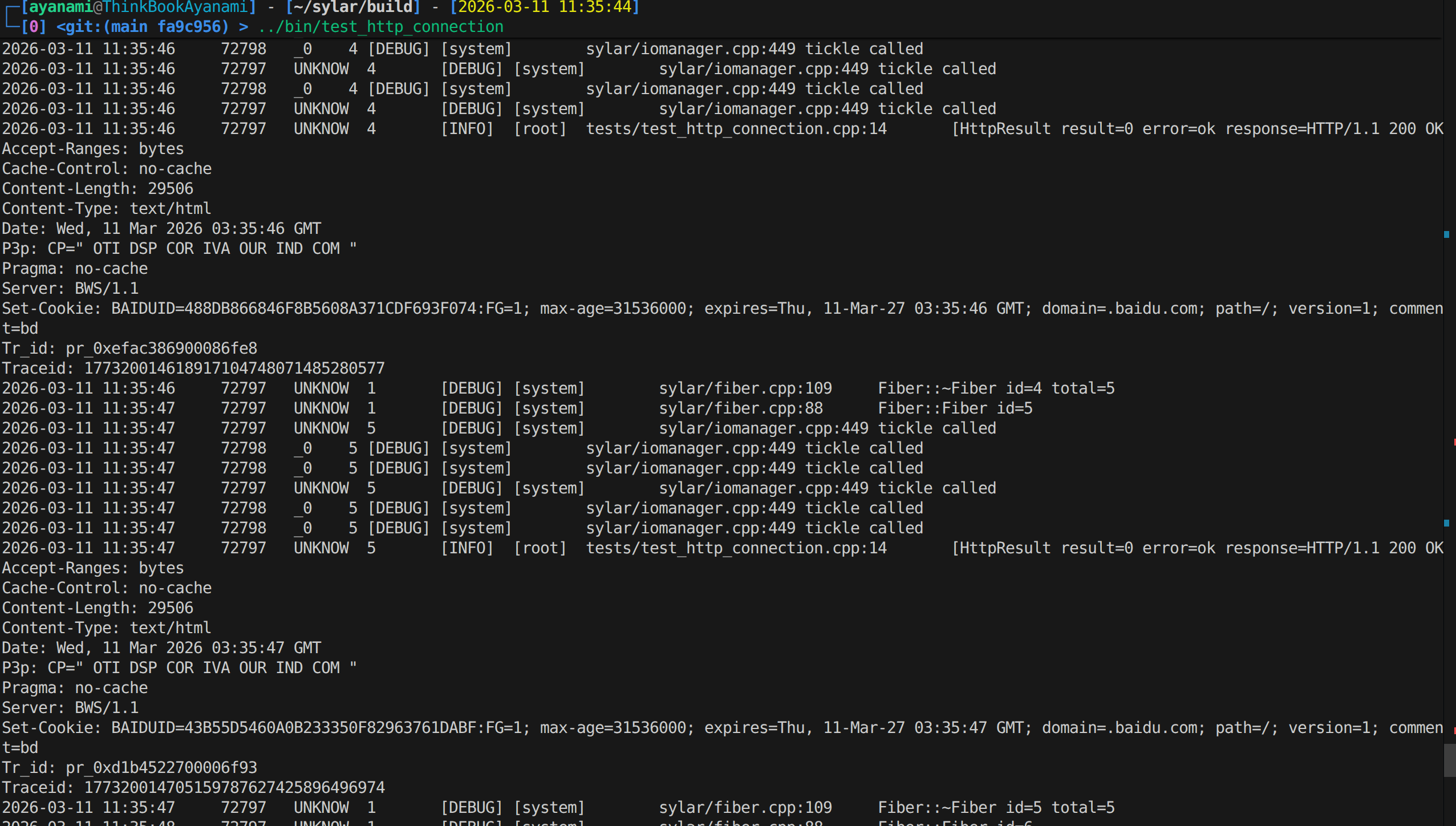
创建一个连接池,目标www.baidu.com的80端口,最大连接数10,最大连接时长30秒,单个连接最多复用5次
#include
<iostream>
#include "sylar/http/http_connection.h"
#include "sylar/log.h"
#include "sylar/iomanager.h"

static sylar::Logger::ptr g_logger = SYLAR_LOG_ROOT();

void test_pool() {
    sylar::http::HttpConnectionPool::ptr pool(new sylar::http::HttpConnectionPool(
        "www.baidu.com", "", 80, 10, 1000 * 30, 5));

    sylar::IOManager::GetThis()->addTimer(1000, [pool](){
        auto r = pool->doGet("/", 300);
        SYLAR_LOG_INFO(g_logger) << r->toString().substr(0, 500);
    }, true);
}
int main(int argc, char** argv) {
    sylar::IOManager iom(2);
    iom.schedule(test_pool);
    // iom.schedule(run);
    return 0;
}
可以看到符合预期
总结
提供了http客户端功能



严肃困惑中……